
- Email admin(at)unesconatcom.mw
- Contact Numbers +265(0)982725714
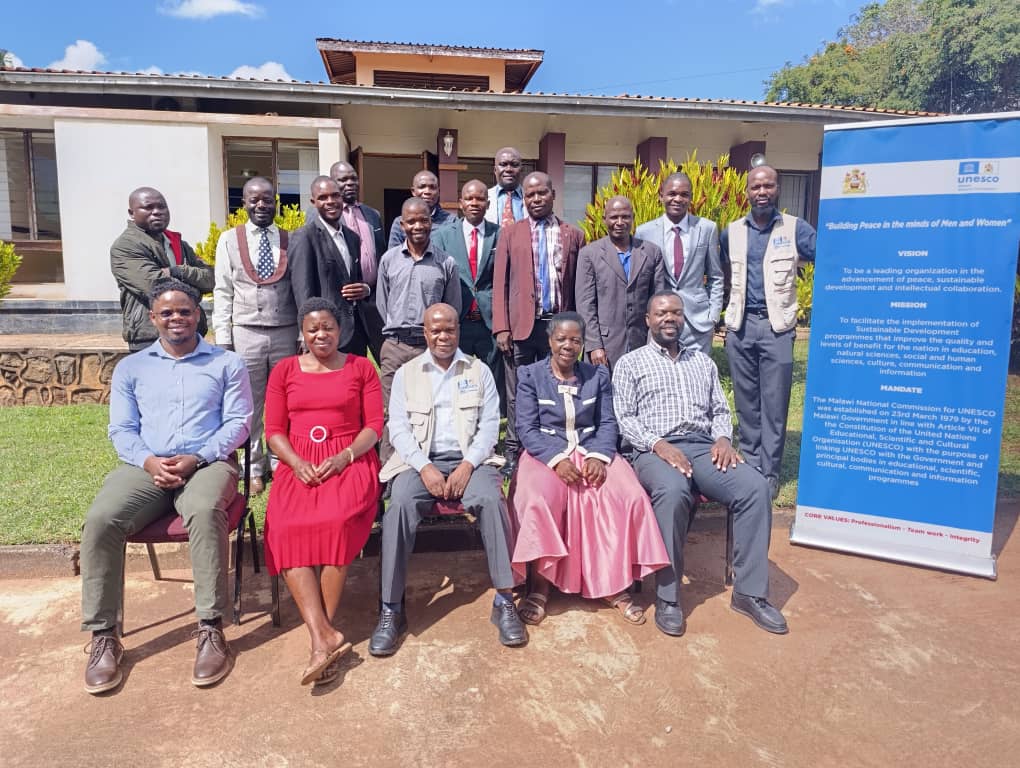

The Malawi National Commission for UNESCO, in collaboration with UNESCO, the Ministry of Education, Science and Technology, and the Ministry of Youth, Sports and Culture, hosted a two-day capacity strengthening workshop in Lilongwe from 9–10 April 2026. The initiative forms part of the regional project, “Safeguarding Intangible Cultural Heritage in Basic Education”, being implemented in Botswana, Malawi, and Zambia with support from the Government of Japan.
The project is being piloted in six primary schools across Malawi, namely: Kaweche in Mzimba, Khurubvi in Nsanje, Lizulu in Ntcheu, Nkhungwa in Mangochi, Kawerezi in Rumphi, and Linthipe in Salima. These schools are at the forefront of integrating living heritage into everyday teaching and learning.

Through interactive sessions, group work, and peer learning, the workshop strengthened teachers’ capacities and developed a guide lesson plan for integrating living heritage while promoting a whole-school approach that actively involves communities, school administrators, teachers and learners.
Intangible cultural heritage such as oral traditions, performing arts, rituals, and indigenous knowledge plays a critical role in shaping identity and community resilience. By integrating these elements into education, learners build stronger connections to their culture while developing respect for diversity.
The outcomes of this workshop will support the use of the standardized guide lesson plans and enhance the implementation of culturally responsive education in Malawi. This marks a significant step toward ensuring that cultural heritage is preserved, practiced, and passed on to future generations through the education system in line with the 2003 Convention for the Safeguarding of the Intangible Cultural Heritage.